
Order vs. Disorder: Surroundings Matter


While our behavior is clearly influenced by our surroundings – most of us act differently in a church vs. a nightclub – new research shows that very subtle differences can have a significant behavioral impact. Specifically, new research shows that environments with “disorder” cues cause people to be less likely to conform to social norms.

Decades ago, the “broken window” theory was proposed. It was based on an observation of old industrial buildings: if a broken window wasn’t repaired promptly, that unfixed window seemed to be an invitation for miscreants to break the rest of the windows. This theory was the basis for Rudy Giuliani’s successful effort to cut crime in New York City that began with cracking down on minor violations, like subway turnstile-jumping and harrassment of drivers by “squeegee men.” The broken window theory had been questioned by some, as it was more anecdotal than research based. Now, new research provides evidence that broken windows are just one example of how behavior is affected by the degree of disorder in our surroundings:

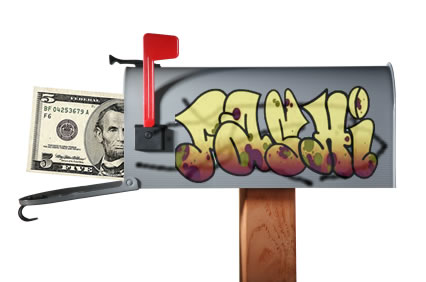
Last month social scientists in the Netherlands empirically demonstrated a phenomenon observed by policymakers and law-enforcement officials for years. When an envelope visibly containing a five-euro note was left hanging out of a mailbox on a sidewalk, 13 percent of the passersby snatched it up. When the same mailbox was covered in graffiti, however, more than double the number of the pedestrians (about 27 percent) stole the envelope.

Graffiti was not the only misdemeanor that fostered a cavalier attitude toward theft. When the ground near the mailbox was covered in litter, 25 percent of the subjects stole the envelope. These results are significant for both social and statistical reasons. Is a disorderly environment responsible for disorderly conduct? [From Seed - Chaos Begets Chaos by Sheila Prakash.]

An even more startling result occurred when the researchers tested compliance with a sign that asked pedestrians not to walk through a gate or chain a bicycle to the fence. A 27% of the people observed by the researchers ignored the sign and walked through anyway. When they chained a bicycle to the fence, though, this number more than tripled, to 82%! Clearly, once they observed the sign being ignored (even by an unrelated offense), the vast majority of pedestrians chose to ignore it too.

While these findings may have great value for city administrators and law enforcement units, what are their neuromarketing implications?

Retail. Since retail environments allow marketers a good degree of control over the surroundings, they are an obvious place to start applying this new research data. It seems likely that casual or opportunistic shoplifting would likely be reduced by maintaining a high degree of order (say, neat racks of apparel ordered by size vs. a messy dump bin) would be a subconscious stimulus that would discourage theft. (As a shopper myself, I’d add that well-organized merchandise would likely increase sales in most cases. On many occasions, I’ve skipped looking for an apparel item in my size to avoid rooting through dozens of disorganized sizes and styles.)

I’m sure there are other marketing applications for this fascinating new knowledge – what are your thoughts?

Related posts:

  1. Order Effect Affects Orders
  2. Laughing Matter: Priming and Mirroring
  3. Priming by Order
  4. Weird News: Cow Names Matter
  5. Product Contagion

This post was written by:

Roger Dooley (author of 557 posts on Neuromarketing.)

Roger Dooley writes and speaks about marketing, and in particular the use of neuroscience and behavioral research to make advertising, marketing, and products better. He is the primary author at Neuromarketing, and founder of Dooley Direct LLC, a marketing consultancy.

24 Responses to “Order vs. Disorder: Surroundings Matter”

  1. Jason Says:

    Extremely interesting stuff!

    Broken window theory has fascinated me since college, when I realized that the neater I kept my things, the less likely it was that my roommate would leave things lying around (and vice-versa). It wasn’t until a sociology class a few years later that I realized there was a name for it ; )

    When you think about it, it’s tough not to see the theory at work everywhere you look… which makes me wonder why more people don’t use it to their advantage.

    A similar concept worth posting about: diffusion of responsibility

  2. Marketing Rooster Says:

    I’m sure Malcolm Gladwell will be gratified to hear about the researchers’ findings!

  3. Ingrid Cliff Says:

    Fascinating!

    I have also seen this in workplaces. Those that are cluttered and full of mess, often have employees who take less care with their work and have a higher rate of employee theft.

    Makes cleaning up a corporate imperative!

  4. Peter Korchnak Says:

    When you look good, you feel strong. When you feel strong, it shows – you look better and people notice. And looking good and strong elicits respect and trust. A virtuous circle!

    Seth Godin has a related post today on beauty as a signal of quality.

  5. Jon-Mikel Bailey Says:

    I think this can be reworked for lots of applications, just just behavior in terms of bad/good activity. Think about Twitter for example, if you have a profile that tells the person nothing specific and your posts are about random topics, you will probably get random followers or none at all. If your profile is specific to how you are and what you do and your posts are appropriate to that, your followers will most likely be in that same world (or at least the majority of them). In my mind perception is the precursor to actual interaction. Good stuff, thanks!

  6. Perry McDowell Says:

    The conclusion regarding retail is not supported by the evidence. There is a difference between “illegal behavior/disobedience” and neatness. While the rate of stealing increased with liter, littering is illegal, so it is more than just “messy.”

  7. spoon Says:

    I’ve never found any convincing evidence that the “broken windows” theory worked. I thought that the improvement in the NYC crime rate was found to have been related to a large number of other factors including population change and initiatives around prevention of re-offending and “incentivising” employment.

    Regarding the graffiti – could it not be possible that the majority of people didn’t even see the money (rather than chose not to take it). Perhaps an evironment with graffiti stimulates the visual senses more than a bland “clean” environment and means that people are actually more aware of their surroundings – they are actually looking more and so are more likely to see the money in the first place?

  8. Peter Kamau Says:

    This just confirms my fears,thanks !!

  9. Jeff Korhan Says:

    We all have a desire to control our environment, and as a result, we respect order in that environment. This is a basic concept of Feng Shui. It takes more energy to maintain disorder than order. When we see order, we make the judgment, right or wrong, that somebody has it all together.

    Early in my career I had a client tell me: “Jeff, what we like about you is you are a neatnik!” It made me laugh – and still does, but the point is, it says a lot about how people make judgments by looking at the big picture – the overall order of things.

    Jeff Korhan

  10. Robert Dominguez, The Restaurant Mentor Says:

    Interesting!

    This theory holds true for restaurants as well. Think about a restaurant that has dirty tables everywhere and the restrooms are messy and smell. It gives you an uneasy feeling about what is happening in the kitchen to your food.

  11. Katherine Says:

    Did the researchers in the study consider pedestrian attention to the mailbox as a possible confounding variable? Perhaps people simply noticed the mailbox (and hence the money) more often when there was an unusual amount of litter or graffiti around it.

  12. Dmitri Eroshenko Says:

    I don’t know whether to laugh or to cry. Oh, human nature.

    This can be explained by the “social proof” phenomenon which is aptly described in “Yes!: 50 Scientifically Proven Ways to Be Persuasive” book:

    http://bit.ly/6HNy

  13. Jonas Says:

    Where I live (Stockholm, Sweden), there is from time to time complaints about traffic behaviour, not at least about bicyclists, brought forward in news articles, radio news and letters to the editor in the main morning papers.

    This suggests such nitpicking might make it worse, contrary to the intention.

  14. dada Says:

    with regarding to retailed, it is about what kind of retailer you mentioned. I live in the Netherlands, here you have several cheap chain shops which I always see that the shops are very unorganized,probably they do that by purpose in order to create kind of impression that we are cheap and pls coming in..

  15. Roger Dooley Says:

    I’ve heard the same thing, dada – by putting product into a messy dump bin, for example, retailers appeal to consumers who expect a bargain in the messy assortment of products.

    Roger

  16. RandomWorker Says:

    I can relate to this. Because of various reasons I attend many weddings and other large occassion where there are a lot of people. In the bathrooms, if it is clean it will stay clean. However, if one person throws a tissue on the floor then most certainly soon there will be many more on the floor. People see a mess and then they seem to think it I ok for them to leave a mess too.

  17. Dbob Says:

    Who remembers the old detective show Columbo
    and the movie “Dial M for Murder”? Columbo was sloppy in appearance and demeanor; the detective in Dial M was well dressed and fastidious. Columbo caused his suspects to not take him seriously, while his counterpart put his suspects on guard!

    Both caught the bad guys/gals. But, used the broken window effect to their advantage. Columbo was on purpose while his counterpart was anal.

  18. patrick voo Says:

    as both an addicted thrift-store shopper and former manager of a high-end sports retail store, i can just relay my own reflections on retail environments – neat and tidy often conveys ‘cost’ (as in to the consumer) – whereas a little bit of disarray (sometimes even a lot) can convey ‘treasure to be found’.

  19. Brock Predovich Says:

    Disorganization puts the mind in mischief. Think about it when you wake into a store and everything is neat and tidy it tells you “this place is cared for” and “everything here is accounted for”. when you walk into clutter it screams “we don’t care for what’s in here” and “I don’t know were anything is”. Disorganization tells the customer that you don’t value your business and you wouldn’t even notice is something was missing.

    Brock
    http://www.brockpredovich.com

  20. Ryan Angelo Says:

    It fascinating how the mind’s thoughts and rationalizations can be directed by seemingly insignificant stimuli.

    -Ryan

    Awesome Blog btw :: I’m subscribing.

  21. Marlin Says:

    “Disorganization puts the mind in mischief.”

    One wonders then, if you wish to have an innovative, insurgent, even revolutionary company, do you need to tolerate, even encourage a certain level of chaos / messiness in the workplace (Google)?

    Conversely, if you’re a authoritarian who wants to keep the populace in your country in line, do you make sure the streets are clean and the trains run on time (Singapore)?

  22. bob ama Says:

    This is nothing to do with broken windows, just ‘the power of suggestion’

  23. Brendon Clark Says:

    Cool thread. One of the (possibly many) subtexts here is the permission we perceive we have when someone else does something first. Interesting links to conformity and social pressure. Makes me think of Stanley Milgram’s work on obedience. When someone else refused to participate in his experiments, it gave permission for the real subject to say no too. And parents who say do as I say, not as I do!

    So for how many behaviours and in how many ways can I give or withhold “permission” in marketing?


Leave a Reply