

Norwegian Cruise Line is in hot water, and not the spa kind. Starting in early 2026, NCL quietly updated signage and FAQs to ban shorts and flip-flops at dinner in six premium specialty restaurant venues: Palomar, Ocean Blue, Onda, Cagney’s, Le Bistro, and the Haven. The backlash was immediate. The New York Post picked up the story, quoting one veteran NCL cruiser who called it a “NEW IDIOTIC RULE” and vowed to take their business elsewhere.
From a brand perspective, the move is complicated. NCL’s entire identity for decades has been “Freestyle Cruising,” a deliberate rejection of the rigid formality that long defined ocean liner culture. Even the timing is awkward. NCL’s current ad campaign, “It’s Different Out Here,” features families dining in sandals.
The loudest complaint from casual-dress defenders on cruise forums? “Does what I’m wearing change how your food tastes?”
Here’s the thing: according to the neuroscience, the answer is yes. And not just in a metaphorical sense.
Your Brain Is Always Predicting
To understand why a stranger’s outfit can affect the taste of your meal, you need to understand how taste perception actually works.
We tend to think of tasting food as a bottom-up process: flavor molecules hit the tongue and nose, signals travel to the brain, and we experience taste. But that’s not quite right. The brain is a prediction machine. Long before the first bite, it has already formed an expectation of what the experience will be, and that expectation shapes what you actually perceive.
Researchers at Stanford and Caltech demonstrated this beautifully in a wine study Subjects were told they were drinking a $45 bottle, then a $5 bottle (in fact, they were the same wine both times). Not only did subjects report enjoying the “expensive” wine more, brain imaging showed measurably higher activity in the medial orbitofrontal cortex, the region associated with pleasure encoding. They weren’t saying what they thought the experimenters wanted to hear. They were actually experiencing more pleasure from the identical wine, simply because their brains had been primed to expect more.
This is why a meal at a restaurant with a two-month waitlist can taste better than the same dish at an empty diner. Your brain has already decided, based on accumulated cues, what’s coming.
The Servicescape: More Than Wallpaper
Once you’re inside a restaurant, a new layer of prediction signals kicks in. Researchers call this the “servicescape,” the totality of the physical and social environment where a service is delivered. Lighting, music, décor, table settings, staff attire, and yes, what fellow diners are wearing. All of these function as inputs into your brain’s ongoing quality forecast.
Mary Jo Bitner’s foundational research established that environmental stimuli reliably shape customer behavior and satisfaction through emotional and cognitive pathways. Bitner’s work showed that the environment changes what people feel, spend, and remember.
A 2018 study in the British Food Journal made this concrete for dining specifically. Researchers found that server attire directly altered customers’ judgments of food quality. Not the food’s presentation, not its preparation, just what the server was wearing. The food was identical. The experience was not.
Work published in Nature Human Behaviour adds another dimension: clothing functions as a rapid status signal, processed in as little as 129 milliseconds, that shifts inferences about competence and expected quality. In nine studies, participants judged the same face as significantly more competent when the clothing appeared “richer.” The effect persisted even when they were explicitly told to ignore the clothing . When we perceive the people around us as high-status, our brains interpret the entire environment as more premium. Before a single bite, expectations have already shifted.
Crossmodal Influences: When Vision Changes Taste
The interaction goes even deeper. Sensory neuroscience has documented extensively that the senses don’t operate in isolation — they influence each other in a process called crossmodal perception.
Charles Spence at Oxford’s Crossmodal Research Laboratory has spent decades documenting how non-gustatory factors shape taste. Ambient sound affects sweetness. Lighting affects flavor intensity. Visual stimuli can change the perceived bitterness or acidity of what you’re eating. These aren’t minor rounding errors. In controlled studies, they produce meaningful differences in subjective experience.
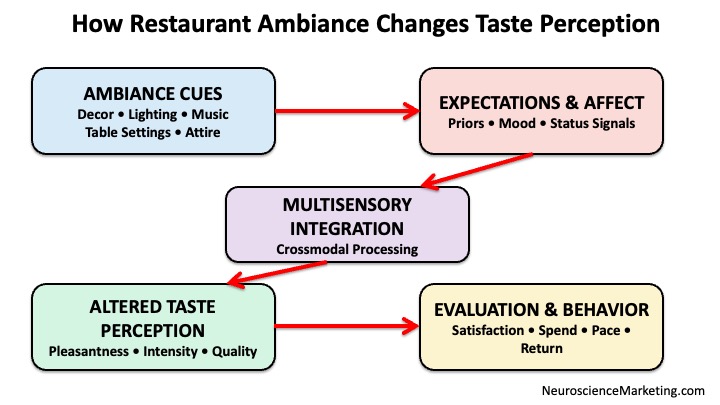
The diagram above illustrates the chain: ambiance cues generate expectations and affect, those flow into multisensory integration (crossmodal processing), which produces altered taste perception, which in turn drives evaluation and behavior — satisfaction, spend, pace, return visits.
Ambiance isn’t background noise, it’s a direct input into the experience.
The Limits of the Effect
Let me add some important nuance here. These effects are most powerful under conditions of subjectivity and uncertainty. If a steak is genuinely overcooked and tough, no amount of ambient elegance will make it delicious. But in the vast middle ground, i.e., where a dish is good but not extraordinary, expectations have the ability to move the needle significantly. A “very good” entrée can become “excellent.” An “okay” dish can improve to “very good.”
Similarly, the signal produced by fellow diners’ attire is probably more meaningful at the extremes. A room full of tuxedos might measurably elevate expectations. But the casual-versus-resort-casual distinction probably has minimal effect. The more impactful signal, almost certainly, is the discordant one, like a premium specialty restaurant where someone at the next table is in a tank top and ball cap. That creates a mismatch between what the brain expected (premium) and what it’s receiving (not premium). Mismatches cost you something in terms of perceived quality.
It’s also worth noting that one’s own experience establishes a set point for appropriate dress. My home town of Austin experiences months of hot weather, often triple digits, and has a strong outdoor dining culture. Even at a high-end steakhouse, one may encounter shorts and t-shirts. If that’s what you are accustomed to, you may take no notice of fellow cruise diners dressed that way. If you’re from Manhattan, Paris, Dubai, Milan, etc. where fine dining restaurants expect patrons to dress appropriately, your subconscious expectations might be impacted by overly casual or sloppy diners.
So NCL isn’t wrong that a dress standard could enhance the perceived dining experience at its specialty restaurants. The science supports the rationale.
The Irony of Awareness
Here’s where it gets philosophically interesting. Most diners are completely unaware that these effects are operating. In the Stanford/Caltech wine study, participants didn’t think they were being influenced by price. They believed they were objectively evaluating the wine. The influence was entirely non-conscious.
This is why the cruise forum debate is slightly beside the point. When a long-pants defender argues that “the dress code improves the experience” and a shorts advocate fires back “my food tastes the same no matter what others wear,” both feel entirely confident in their positions. Neither has introspective access to the actual mechanism at work. The brain integrates these environmental signals well below the level of awareness.
That doesn’t make one side right and the other wrong. It means the question “does it change how your food tastes?” is harder to answer than it appears, and the honest answer, based on the evidence, is: it depends on the context, the dish, and the gap between expectation and reality.
What This Means Beyond Cruise Ships
The servicescape principle applies everywhere a service is delivered. Retail environments, hotel lobbies, healthcare waiting rooms, fitness studios, etc. are constantly broadcasting quality signals to brains that are constantly predicting what the experience will be.
Experience designers who understand this think about every element of the environment as a cue that either reinforces or undermines the expectation they want to set. A premium gym with cracked floor tiles is sending a contradictory signal. A casual cafe with formal, stiff service is creating cognitive dissonance. The goal is coherence. An environment should have all the signals pointing in the same direction, creating a consistent and believable expectation.
For NCL, the challenge isn’t that the science is wrong. It’s that the dress code introduces coherence into the specialty restaurant experience while simultaneously breaking coherence at the brand level. The specialty venue signals “premium.” The parent brand continues to signal “casual.” Those two signals are hard to hold simultaneously. Loyal customers who feel the contradiction are experiencing a very real form of the same mismatch that the dress code is trying to eliminate inside the restaurant.
The lesson for any experience designer: setting expectations accurately is just as important as setting them high. Your customers’ brains are always predicting. Make sure all your signals are telling the same story.

