

 For years, neuromarketing meant one thing: expensive lab equipment, complicated studies, and a budget most businesses could never justify. fMRI scanners. EEG caps. Eye-tracking sensor arrays. Applying behavioral science meant expensive consultants or hiring your own experts. If you wanted to know what was really going on in your customers’ heads, you needed deep pockets. That’s the big reason my first book, Brainfluence, focused on simple, research-based strategies that anyone could use.
Today, that world of big-budget domination is gone. My new book is about what replaced it.
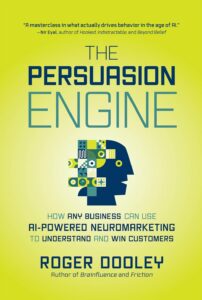
The Persuasion Engine: How Any Business Can Use AI-Powered Neuromarketing to Understand and Win Customers is available now.
The big idea is what I call Neuromarketing 2.0. Classic neuromarketing was very useful but out of reach for almost everyone. Then a few things happened at once. Remote tools let researchers track attention and record biometrics through ordinary device cameras and wearables. Machine learning got good enough to create AI tools that accurately predict where people look without testing a single human. And generative AI put consumer psychology expertise and empathetic communication into the hands of anyone who knows how to ask for it.
Add it up and you get something new: neuroscience, marketing, behavioral science, and AI converging into a single toolkit. One that a solo founder, a small agency or any marketing team can actually use.
That last part matters most to me. The whole point of The Persuasion Engine is that you no longer need a giant research budget to understand your customers at a deep level. The tools that once belonged to the Fortune 500 are now available to everyone, often for the price of a monthly AI subscription.
 A few people whose work I’ve admired for years had kind things to say. Robert Cialdini, author of Influence and Pre-Suasion, wrote that the book “shows entrepreneurs how to use AI, neuromarketing, and behavioral science to punch far above their weight.” Rory Sutherland, Vice Chairman of Ogilvy, called it “the marketing equivalent of The Imitation Game — decoding the often bizarre and hard to predict mass of internal wiring which lies between objective reality and human behaviour.” There are generous words from Nir Eyal, Paul Zak, Mark Schaefer, and Marshall Goldsmith, too.
What’s Different About This Book
The Persuasion Engine resembles my previous two books, Brainfluence and Friction, in its focus on a science-based approach to marketing presented in an entertaining and easily accessible way. It differs in its emphasis on timely, practical, tactical content. My first two books are as relevant today as when I wrote them. The Persuasion Engine is packed with specifics: AI models, detailed prompts, etc. The Persuasion Engine offers readers the specific tools to apply the ideas in my earlier books in just seconds using AI— even if you haven’t read them! (Please read them anyway!) And it’s not just about applying my ideas, these techniques let you apply the insights of Kahneman, Cialdini, Ariely, Fogg, and all the other luminaries in this space… in mere minutes.
This hands-on emphasis raised an important question: How can I keep the book relevant and useful when the technology is changing so quickly?
That dilemma kept me from starting the book earlier. But, Wiley, my publisher, often publishes titles about rapidly evolving areas, and encouraged me to move forward. These high growth spaces are often the things readers are most interested in.
I finally hit on a solution to the rapid obsolescence problem. First, I wrote the AI chapters to show readers how to think about using AI, in addition to providing detailed prompts. And, at the end of each chapter, I include a link to a micro-site where I have updates and copy-and-paste prompts (Nobody wants to type in long prompts while trying to hold a book open!) As a bonus, I also include enhanced and new prompts that improve on the ones in the book but were too long to be practical in a print book. This is living content, I add to it often!
If you’ve followed this blog, you already know I think most marketing fails because it talks to the rational brain while the decision is being made somewhere else entirely. The Persuasion Engine is my attempt to hand you the tools to reach that other place — and to do it without a lab, a PhD, or a seven-figure budget.
Go take a look: The Persuasion Engine at Amazon.

